

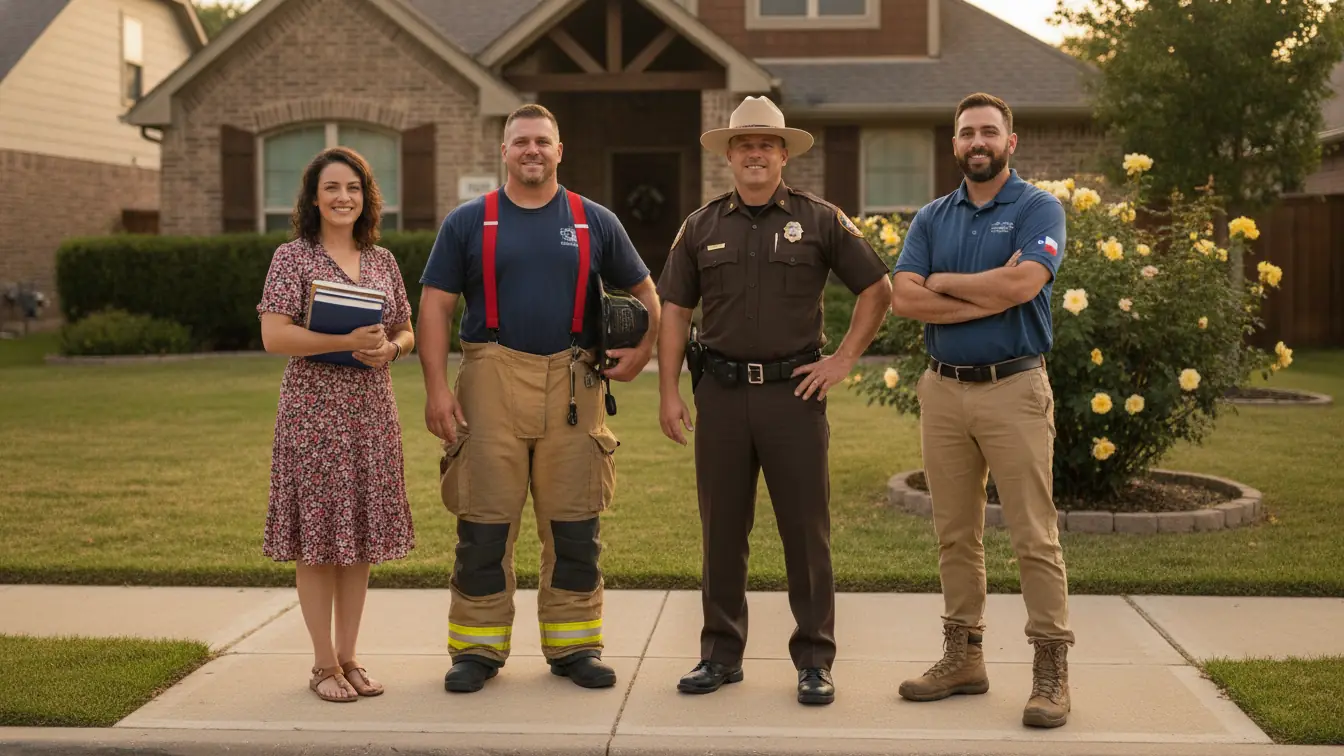
If you work in a Texas classroom, hospital, fire station, or correctional facility, you have probably heard about down payment assistance for public servants—only to find that the actual job rules are surprisingly strict.
This guide breaks down the official 2026 Homes for Texas Heroes eligible professions list from the Texas State Affordable Housing Corporation (TSAHC), including the exact statutory definitions, edge cases for nurses and veterans, and the employment verification your lender will need.
Check Your Texas Heroes Home Loan Eligibility
You will see right away whether your exact role qualifies for the TSAHC Heroes program, why the 2025 bills to add hospital nurses and social workers stalled, and how to get the exact same 2% to 5% assistance through an alternative track if your job title falls outside the rules.
How TSAHC Defines Eligible Professions in 2026
The Homes for Texas Heroes home loan program is governed by Texas statute and TSAHC's official lender guidelines (revised September 9, 2026). TSAHC limits the Heroes program to 11 specific profession categories.
To qualify under any non-military category, you must be employed full-time in that role. However, you do not have to live in Texas before applying: TSAHC rules state that borrowers must currently live in Texas or show intent to become residents, and people not yet living in Texas who have accepted a job in an eligible profession qualify.
Why does landing on the Heroes list matter? Both Homes for Texas Heroes and TSAHC's sister program, the Home Sweet Texas Home Loan Program, offer the same 30-year fixed-rate mortgages and 2% to 5% down payment assistance (as a grant or 3-year deferred forgivable second lien, plus a 4% or 5% 30-year repayable Bond option when available). Being on the Heroes list gives you two distinct advantages:
- Higher county income limits on Non-Bond and No-DPA loans (for example, $176,800 in Harris County and $205,870 in Dallas County for Heroes, compared to $156,000 and $181,650 for Home Sweet Texas).
- A waived $400 issuance fee when you pair Non-Bond down payment assistance with a TSAHC Mortgage Credit Certificate (MCC), which gives first-time buyers a federal tax credit equal to 15% of their annual mortgage interest.
Quick Self-Check: All 11 Eligible Profession Categories
Use this summary table from TSAHC's September 9, 2026 guidelines to check your category before reading the detailed rules and exclusions below.
| Profession Category | Who Qualifies (Must Be Full-Time) | Common Exclusions / Edge Cases |
|---|---|---|
| Professional Educator | Public K-12 classroom teacher, teacher aide, school librarian, school counselor, or school nurse | Private school staff, part-time staff, school clerical or cafeteria workers |
| Fire Fighter | Permanent fire department member in fire suppression, inspection, arson investigation, marine/aircraft firefighting, training, education, or administration | Fire department secretaries, clerks, budget analysts, and similar support staff |
| Peace Officer | Full-time peace officer elected, employed, or appointed under Texas law (licensed through TCOLE) | Support staff who are not peace officers |
| Emergency Medical Services (EMS) | Emergency care attendant, EMT, EMT-Intermediate, EMT-Paramedic, or licensed paramedic | Roles outside the listed EMS certifications |
| Corrections Officer | Texas Department of Criminal Justice (TDCJ) employee who receives hazardous duty pay | TDCJ employees who do not receive hazardous duty pay |
| Juvenile Corrections Officer | Texas Juvenile Justice Department (TJJD) employee who receives hazardous duty pay | TJJD employees who do not receive hazardous duty pay |
| County Jailer | County jail guard employed under Local Government Code §85.005 (licensed through TCOLE) | Jail staff not employed as county jail guards |
| Public Security Officer | Armed security officer employed or appointed by the state or a political subdivision (licensed through TCOLE) | Security officers employed by private security contractors |
| Nursing Faculty Member | Faculty member in an undergraduate or graduate professional nursing program | Hospital, clinic, or private-practice RNs, LVNs, and APRNs |
| Allied Health Faculty Member | Faculty member in an undergraduate or graduate allied health program at a Texas public or private institution of higher education | Clinical allied health workers who are not higher-education faculty |
| Veteran / Active Military | Active duty stationed in Texas (with Texas home of record), qualifying veterans, Texas National Guard, or unmarried surviving spouses | Veterans who do not meet the Texas residency tests |
Check Your Texas Heroes Home Loan Eligibility
Detailed Breakdown of Eligible Professions and Edge Cases
Because participating lenders must verify your exact job function before locking a TSAHC loan, it helps to see how each category works in plain English.
Educators and Public School Employees (Texas Teacher Home Loan)
TSAHC groups school employees under the Professional Educator category. To qualify for a Texas teacher home loan through Homes for Texas Heroes, you must work full-time in a Texas public K-12 school in one of five specific roles:
- Classroom teacher
- Teacher aide
- School librarian
- School counselor
- School nurse
Notice how specific that list is. Full-time public K-12 teacher aides, counselors, librarians, and school nurses get the exact same benefits as classroom teachers. However, private school teachers, college professors outside of nursing or allied health, and school support staff (such as bus drivers, cafeteria staff, or front-office clerks) are not included in the Professional Educator definition.
First Responders, Law Enforcement, and Corrections
If you are looking for a Texas first responder home loan, TSAHC covers seven distinct public safety roles, each tied to a specific Texas statute, agency, or licensing requirement:
- Peace Officers: Must be elected, employed, or appointed full-time under Texas Code of Criminal Procedure Article 2.12, Education Code §51.212 or §51.214, or other applicable law. Peace officers are licensed through the Texas Commission on Law Enforcement (TCOLE).
- Fire Fighters: Must be permanent, full-time fire department employees performing functions under Government Code §419.021(3)(C). This covers fire suppression, fire inspection, fire and arson investigation, marine firefighting, aircraft rescue and firefighting, fire training, fire education, fire administration, or other positions customarily related to fire prevention or suppression. TSAHC guidelines explicitly exclude secretaries, clerks, budget analysts, and similar support or administrative staff.
- Emergency Medical Services Personnel: Defined under Health and Safety Code §773.003 as full-time emergency care attendants, EMTs, EMT-Intermediates, EMT-Paramedics, or licensed paramedics.
- Corrections Officers: Must work full-time for the Texas Department of Criminal Justice (TDCJ) and receive hazardous duty pay.
- Juvenile Corrections Officers: Must work full-time for the Texas Juvenile Justice Department (TJJD) and receive hazardous duty pay.
- County Jailers: Must be employed full-time as a county jail guard under Local Government Code §85.005 and licensed through TCOLE.
- Public Security Officers: Must be employed or appointed full-time as an armed security officer by the state or a political subdivision and licensed through TCOLE. Officers employed by private security contractors are excluded.
Healthcare Academic Faculty (Nursing and Allied Health)
Higher-education instructors qualify only if they teach the next generation of healthcare workers full-time:
- Nursing Faculty Member: A full-time faculty member in an undergraduate or graduate professional nursing program.
- Allied Health Faculty Member: A full-time faculty member in an undergraduate or graduate allied health program at a public or private institution of higher education in Texas.
Veterans, Active-Duty Military, and Surviving Spouses
Unlike the civilian categories, the Veteran category is based on military service rather than a civilian job title. Under TSAHC guidelines, you qualify under either of two paths:
- Active Duty in Texas: You are currently serving on active duty at a military base or facility in Texas at the time of application, and you have designated Texas as your home of record.
- Qualifying Veterans and Texas National Guard: You meet all three of the following requirements:
- Service: You served at least 90 days of active duty after September 16, 1940 (unless discharged sooner for a service-connected disability) in the Army, Navy, Air Force, Coast Guard, U.S. Public Health Service, or Marine Corps and were not dishonorably discharged; or you have at least 20 years of active or reserve service; or you enlisted or were appointed in the Texas National Guard, completed initial active duty training, and were not dishonorably discharged; or you served in the armed forces of the Republic of Vietnam between February 28, 1961 and May 7, 1975.
- Prior Texas Tie: You were a bona fide Texas resident at enlistment, or you have lived in Texas for at least one year before applying.
- Current Residency: You are a bona fide Texas resident at the time of application.
TSAHC's veteran definition also includes the unmarried surviving spouse of a qualifying veteran who died or is missing in action. Veterans and active-duty buyers can pair Homes for Texas Heroes with VA loans in Texas, FHA loans in Texas, USDA loans, or HFA conventional loans.
One important distinction if you are adding a Mortgage Credit Certificate (MCC) or using Bond DPA: both require you to be a first-time homebuyer (no ownership in a principal residence in the past 3 years), unless you buy in a Targeted Area or qualify for the federal "Qualified Veteran" waiver under 38 U.S.C. §101. TSAHC notes that active-duty service members are not considered Qualified Veterans for that first-time buyer waiver.
Check Your Eligibility as a Teacher, First Responder, or Veteran
Why Hospital Nurses and Social Workers Are Not on the 2026 List
One of the most common points of confusion for Texas homebuyers is whether registered nurses (RNs), licensed vocational nurses (LVNs), or licensed social workers qualify for Homes for Texas Heroes.
As of TSAHC's September 9, 2026 guidelines, hospital nurses, clinic nurses, and licensed social workers do not qualify for the Heroes program. The only nurses who qualify for Homes for Texas Heroes are full-time public K-12 school nurses (as Professional Educators) and full-time nursing faculty members in undergraduate or graduate nursing programs.
Why do so many websites say nurses and social workers might qualify? During the 2025 regular session of the 89th Texas Legislature, lawmakers introduced two bills to expand the Heroes list in Government Code §2306.5621:
- Senate Bill 536 (SB 536): Would have added nurses licensed under Occupations Code Chapter 301 (excluding advanced practice registered nurses).
- Senate Bill 845 (SB 845): Would have added licensed social workers.
Neither bill passed. According to the official legislative record, both SB 536 and SB 845 were left pending in the Senate Local Government Committee on April 28, 2025. Because the legislature did not enact either bill, TSAHC cannot include hospital nurses or social workers in the Homes for Texas Heroes program.
What If Your Job Is Not on the List? (Home Sweet Texas & TDHCA)
If you are a hospital RN, a licensed social worker, a private school teacher, a school bus driver, or work in any other field, you are not locked out of TSAHC down payment assistance.
TSAHC runs a second program alongside Heroes called the Home Sweet Texas Home Loan Program, and the Texas Department of Housing and Community Affairs (TDHCA) runs the My First Texas Home Program and My Choice Texas Home Program. Here is how Home Sweet Texas compares side by side with Homes for Texas Heroes:
| Program Feature | Homes for Texas Heroes | Home Sweet Texas |
|---|---|---|
| Occupation Requirement | Must fall in 1 of the 11 eligible categories (full-time in a listed profession, or a qualifying veteran) | None (open to all occupations meeting income limits) |
| Down Payment Assistance | 2%, 3%, 4%, or 5% Grant or 3-year Forgivable 2nd Lien; or 4%–5% 30-year Repayable Bond 2nd Lien | Identical: 2%, 3%, 4%, or 5% Grant or 3-year Forgivable 2nd Lien; or 4%–5% 30-year Repayable Bond 2nd Lien |
| Minimum Credit Score | 620 (FHA, VA, USDA); 640 (HFA Conventional or Manufactured Homes) | Identical: 620 (FHA, VA, USDA); 640 (HFA Conventional or Manufactured Homes) |
| First-Time Buyer Required? | Not for Non-Bond DPA or No DPA; required for Bond DPA and MCC | Identical: Not for Non-Bond DPA or No DPA; required for Bond DPA and MCC |
| Non-Bond County Income Limits | Higher (e.g., $176,800 in Harris County; $228,480 in Travis County) | Standard (e.g., $156,000 in Harris County; $201,600 in Travis County) |
| MCC Issuance Fee ($400) | Waived ($0) when combining Non-Bond DPA + MCC | Charged ($400) when adding an MCC |
For a full breakdown of how county income caps work across both tracks, see our guide to Homes for Texas Heroes Income Limits and Texas Homebuyer Income & Purchase Price Limits. You can also compare all statewide options in our Texas First-Time Homebuyer Grants & Programs (2026) guide.
Employment Documentation Your Lender Will Need
When you apply through a participating lender, the lender checks that you meet TSAHC's employment or military service rules. Your lender will confirm the exact documents, but here is what TSAHC's materials point to by category:
- Verification of Employment (VOE): Proof that you are employed full-time in the qualifying role. If you are relocating, ask your lender how to document that you have accepted a job in an eligible profession.
- TCOLE Licensing: Peace Officers, County Jailers, and Public Security Officers are licensed through the Texas Commission on Law Enforcement, so expect your role and licensing to be part of the review.
- TDCJ Verification (Corrections Officers): TSAHC's Homes for Texas Heroes page notes that verification of employment for TDCJ employees is handled through TDCJ. Eligibility requires full-time employment with hazardous duty pay.
- TJJD Verification (Juvenile Corrections Officers): A verification of employment through the Texas Juvenile Justice Department is required. Eligibility requires full-time employment with hazardous duty pay.
- Military & Veteran Documentation: According to TSAHC, a DD214 or discharge papers prove service for veterans. Active-duty buyers should ask their lender what documents show their Texas assignment and home of record.
Along with verifying your profession, you will need to meet standard requirements to buy a house in Texas under TSAHC rules: a minimum 620 credit score for government loans (640 for HFA conventional or manufactured homes), completion of an approved homebuyer education course before closing, and moving into the home as your principal residence within 60 days of closing. Program interest rates are set daily by TSAHC, and a participating lender can quote today's rate for your chosen assistance level.
Next Steps to Check Your Eligibility
Whether you are a public school teacher, a peace officer, a TJJD or TDCJ officer, a veteran, or a healthcare worker comparing Homes for Texas Heroes against Home Sweet Texas, the fastest way to get a clear answer is to check your job title, county income limit, and credit profile up front. Buyers apply for TSAHC programs through a participating lender, and our team, including Texas loan officer Phil Ganz, can help you verify which track fits your profession, compare your 2% to 5% assistance options, and get connected to take your next step.
Ready to Get Started?
Check your eligibility in under 2 minutes. No credit pull, no obligation.
Get our Texas updates in your Google feed
Add Make Texas Your Home as a preferred source to see our rate, grant, and program updates more often in Google Search.