

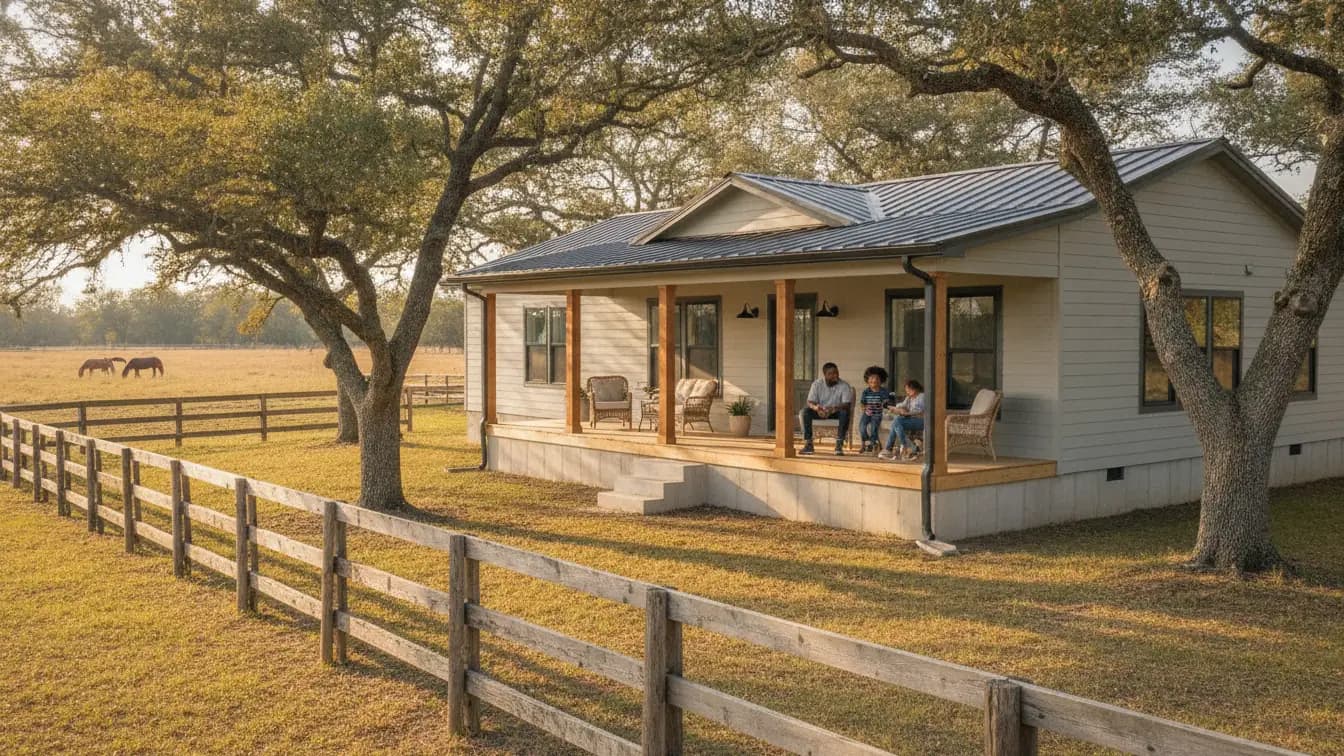
Buying a manufactured home in Texas can put a yard and a roof of your own within reach, yet many buyers hit a wall when they discover that financing a factory-built home works differently than buying a traditional brick house.
This 2026 guide walks you through Texas manufactured home loans, from how the state titles manufactured homes and how to convert one into real estate to the exact rules for FHA loans, Fannie Mae, VA loans, and USDA loans.
Check Your Texas Manufactured Home Loan Eligibility
By the end, you will know whether your purchase calls for a real-estate mortgage or a personal-property loan, what paperwork the state and your lender will ask for, and the right questions to ask before you sign a contract.
Manufactured Home vs. Mobile Home under Texas Law
Shoppers and real estate listings often use the phrase "mobile home loan Texas" to describe any factory-built home loan, but Texas statutes and mortgage underwriters draw a hard line by the date the home was built.
Under Texas Occupations Code Section 1201.003, a HUD-code manufactured home is a structure built on or after June 15, 1976, according to federal Department of Housing and Urban Development (HUD) standards, constructed on a permanent chassis, transportable in one or more sections, and measuring at least 8 feet wide or 40 feet long in traveling mode (or at least 320 square feet when erected on site).
A mobile home is the same kind of structure built before June 15, 1976. Texas law states that a mobile home is not a HUD-code manufactured home, and vice versa, for any purpose. Among Texas home loan options, FHA requires a home built on or after June 15, 1976, and Fannie Mae requires a home built to the federal HUD code.
(Note: At the federal level, the 21st Century ROAD to Housing Act, enacted July 11, 2026, includes a provision to remove the permanent-chassis requirement from the federal manufactured-home definition pending new HUD standards. However, the current HUD Handbook 4000.1 and the 2023 Texas Occupations Code compilation still reference a permanent chassis, so buyers should confirm current chassis guidelines with their lender.)
How Texas Titles Manufactured Homes: The Statement of Ownership
In Texas, ownership of a manufactured home is shown on a document issued by the Texas Department of Housing and Community Affairs (TDHCA) called a Statement of Ownership (often abbreviated SOL).
Under Texas Occupations Code Sections 1201.205 and 1201.206, the Statement of Ownership is the TDHCA-issued document showing who owns a manufactured home in Texas. At the first retail sale of a manufactured home, the retailer is required to send the completed Statement of Ownership application to TDHCA within 60 days of the sale.
According to TDHCA MHD Form 1037 (Revised 06/03/26), the standard fees and paperwork for a Texas Statement of Ownership manufactured home filing include:
| TDHCA Statement of Ownership Item | Requirement / Published Fee |
|---|---|
| Standard Statement of Ownership issuance fee | $55 |
| Missing HUD label or Texas Seal fee | Addendum required plus $35 per Texas Seal per section ($35 single, $70 double, $105 triple) |
| Electing real property status | Mark Block 6 "real property" with qualifying election and attach a copy of the legal description or warranty deed |
| Existing personal-property liens | Must be released (TDHCA Form B, signed lienholder copy, or payoff documentation) or covered by a statement from a title company, attorney, or federally insured institution issuing a title commitment or policy that covers all liens |
| Home sold within the previous 18 months | Tax statement or "paid in full" receipt required, unless closing through a title company or attorney insuring the home with the land |
How a Manufactured Home Becomes Real Property in Texas
Whether your home is treated as real property (real estate) or personal property (chattel) is a major factor in what kind of manufactured home loan you can use. FHA Title II, Fannie Mae, and USDA all require the home to be real property, while FHA Title I can finance a home that stays personal property.
Texas Occupations Code Section 1201.2055 sets a strict legal checklist for converting a manufactured home to real property:
- Qualifying land attachment: You may elect real property status on your TDHCA Statement of Ownership application only if the home is attached to land that you own, or land leased to you under a long-term lease as defined by TDHCA rules (§1201.2055(a)).
- TDHCA issuance: You submit the Statement of Ownership application electing real property status, and TDHCA issues a copy of the Statement of Ownership reflecting that election.
- The 60-day recording and notice deadline: Within 60 days after TDHCA issues the Statement of Ownership, you must file it in the county real property records where the home is located and notify both TDHCA and the chief appraiser of the appraisal district (§1201.2055(d)).
- Perfection: Under Section 1201.2055(e), the real-property election is not perfected until the county filing and both notifications are completed. Once perfected, the home is considered "real property for all purposes," and no new Statement of Ownership is required unless the home is moved, the election is changed, or its use changes under §1201.216 (§1201.2055(g)).
If a mortgage closed and the deed of trust was recorded, but the title company or attorney never finished the conversion steps, Texas law allows the loan holder or servicer to complete the conversion later after giving the record owner at least 60 days' prior notice by certified mail (§1201.2055(i)).
Real Property Mortgages vs. Chattel Loans
If the home stays personal property, the Statement of Ownership on file with TDHCA remains the evidence of ownership, and a lender can record a lien only by filing with TDHCA (§1201.2055(c); §1201.219(b)). Financing for a personal-property home is called a chattel loan.
Here is how the two financing tracks compare in Texas:
| Feature | Real Property Mortgage (Home + Land) | Personal Property / Chattel Loan (Home Only) |
|---|---|---|
| Legal classification | Real property perfected under TX Occ. Code §1201.2055 | Personal property on file with TDHCA |
| Land requirement | Borrower owns the land (or holds an eligible long-term lease) | No real-property election required (for example, a home on a leased site in a community) |
| How the lien is recorded | Deed of trust recorded in county real property records | Lien filed directly with TDHCA on the Statement of Ownership |
| Eligible loan programs | FHA Title II, Fannie Mae, VA, USDA | FHA Title I, VA (not permanently affixed category) |
| Maximum loan term | Up to 30 years under FHA Title II | Shorter terms (for example, 20 years and 32 days on FHA Title I home-only loans per HUD's August 2026 handbook) |
Check Your Texas Manufactured Home Loan Eligibility
Loan Programs for Texas Manufactured Homes in 2026
Once you know whether you are financing a home with land as real estate or financing the home as personal property, you can match your purchase to the right loan program. For a broader look at how credit, income, and assets work across mortgage types, review our guide on the requirements to buy a house in Texas.
FHA Title II Manufactured Home Loans (Real Property)
FHA Title II is the standard FHA real-estate mortgage. Under 24 CFR 203.43f and HUD Handbook 4000.1 (Update 18, revised August 12, 2026), a manufactured home must meet all of the following rules to qualify for Title II financing:
- Built date and HUD label: Built on or after June 15, 1976, verified by an affixed HUD Certification Label (a 2-by-4-inch aluminum plate at one end of each section) or a HUD label-verification letter. If the label is missing, the lender gets label verification from IBTS.
- Minimum size: At least 400 square feet of floor area, designed as a one-family dwelling.
- Real estate and foundation: Classified as real estate (it need not be taxed as real estate under the Handbook), built on and remaining on a permanent chassis, and set on a permanent foundation constructed according to the Permanent Foundations Guide for Manufactured Housing (PFGMH).
- Engineer or architect certification: The lender must obtain a PFGMH foundation certification from a licensed engineer or architect in the home's state (Texas). If the home was previously financed with an FHA loan, the prior FHA foundation certification can be reused if there have been no alterations or damage since.
- Single-site installation: The home must have been moved directly from the manufacturer or dealer to the site.
- Flood elevation: The finished grade beneath the home must be at or above the 100-year flood elevation, and homes in FEMA flood zones A or V require a Letter of Map Amendment (LOMA), Letter of Map Revision (LOMR), or elevation certificate.
FHA Title II uses the same credit and down payment tiers as site-built Texas FHA loan requirements:
- Credit score 580 or higher: Minimum Required Investment (down payment) of 3.5% (up to 96.5% loan-to-value).
- Credit score 500 to 579: Minimum 10% down (maximum 90% loan-to-value).
- Mortgage insurance: 1.75% upfront mortgage insurance premium (which can be financed) plus an annual premium. For a typical 3.5%-down, 30-year loan at or below $726,200, the annual premium is 0.55% for the life of the loan.
- Maximum term: Up to 30 years.
- Loan limits: Subject to county Texas FHA loan limits. For Calendar Year 2026, the 1-unit FHA floor across 229 Texas counties is $541,287, rising to $557,750 in the San Antonio metro, $563,500 in Dallas-Fort Worth, and $571,550 in the Austin metro. These are the current published HUD figures, and they change yearly, so confirm your county's limit with a lender.
FHA Title I Manufactured Home Loans (Chattel, Lot, or Combination)
If you are placing a manufactured home in a community on a leased pad or keeping the home classified as personal property, FHA Title I (HUD Handbook 4000.1, Section II.E.4) offers a government-insured alternative.
- Eligible loan types: Home-only loan, lot-only loan, or a combination home-and-lot loan. The home may be treated as personal property (chattel) or realty.
- Credit score and down payment: HUD has not established a minimum credit score for Title I. Borrowers with a credit score above 500 need a minimum cash investment of 5% (95% maximum LTV), while borrowers with a score of 500 or below need 10% down (90% maximum LTV).
- Borrower ID requirement: Every borrower on a Title I loan must have a valid Social Security Number (SSN). Also note that under HUD Title I Letter 490 and Mortgagee Letter 2025-09 (effective for case numbers assigned on or after May 25, 2025), non-permanent residents are no longer eligible for FHA Title I or Title II loans; borrowers must be U.S. citizens, lawful permanent residents, or citizens of the Federated States of Micronesia, the Republic of the Marshall Islands, or Palau.
- Leased land rules: If the home sits on a leased site in a manufactured home community, the lease must run for at least 3 years, be renewable, and give the homeowner at least 180 days' advance notice before termination.
- Upfront insurance charge: 2.25% of the base loan amount.
- Loan limits and maximum terms: HUD Handbook 4000.1 (revised August 12, 2026) lists maximum terms of 15 years and 32 days (lot only), 20 years and 32 days (home only or single-unit combination), and 25 years and 32 days (multi-unit combination). Section 303 of the 21st Century ROAD to Housing Act (law since July 11, 2026) raises FHA Title I loan limits and extends terms to 30 years. HUD's implementation of the new dollar limits has not been confirmed, so check current Title I loan limits and terms with a Title I lender.
Conventional Loans: Fannie Mae and Freddie Mac
Conventional loans are those sold to Fannie Mae and Freddie Mac. All 254 Texas counties share a baseline 1-unit Texas conforming loan limit of $832,750 for 2026, according to FHFA. Confirm the current figure with a lender, since it changes yearly.
Under Fannie Mae Selling Guide sections B5-2-02 (dated 12/10/2025) and B2-3-02 (dated 02/04/2026), standard Fannie Mae manufactured housing requirements include:
- Real property only: The mortgage must be secured by both the manufactured home and the land, and both must be legally classified as real property under Texas law. Fannie Mae does not purchase chattel loans. (A home on leased land is eligible only if the borrower owns the home and the community is approved through Fannie Mae's PERS review.)
- Size and construction: Built to the federal HUD code (24 CFR Part 3280), at least 12 feet wide, with at least 400 square feet of above-grade finished area.
- HUD Label or Data Plate photos: The home must show a HUD Certification Label(s) or HUD Data Plate, and photos are required. The Data Plate is the paper document inside the home showing the manufacturer, serial number, model, date of manufacture, and wind/roof-load/thermal zone maps. If neither can be obtained, the home is ineligible for Fannie Mae, and newly constructed homes must have both.
- Foundation and occupancy: On a permanent foundation system with hitch, wheels, and axles removed, and connected to utilities. Primary residences may be single-width or multi-width. Second homes must be multi-width, and investment properties and co-op projects are ineligible.
- MH Advantage: Fannie Mae's MH Advantage requires an MH Advantage sticker or CHOICEHome label, a masonry or poured-concrete perimeter foundation, a covered porch of at least 72 square feet, a driveway, a sidewalk, and gutters (plus an attached garage or carport for new single-section MH Advantage homes manufactured after June 4, 2026). Fannie Mae says MH Advantage allows higher loan-to-value ratios under its Eligibility Matrix, but the exact down payment and loan-to-value figures for standard MH and MH Advantage should be confirmed with your lender.
On the Freddie Mac side, two 2026 updates expanded options for manufactured homeowners: Freddie Mac Bulletin 2026-4 (April 1, 2026) increased the maximum loan term on cash-out refinances of manufactured homes from 20 years to 30 years for Accept mortgages, and Bulletin 2026-7 (June 3, 2026) made manufactured homes eligible for Freddie Mac Renovation Mortgages and for properties with incomplete improvements.
VA and USDA Manufactured Home Loans
- VA Manufactured Home Loans: Under 38 CFR Part 36, Subpart A, eligible veterans can use a VA loan in Texas to buy a single- or double-wide manufactured home with or without a lot, buy a lot for a veteran-owned home, or refinance an existing manufactured home loan. For a new home-only loan, the maximum loan is generally 95% of the purchase price, capped by an invoice-based formula, and the VA Buyer's Guide lists a 1.0% funding fee for manufactured home loans that are not permanently affixed.
- USDA Section 502 Guaranteed Loans: Under 7 CFR 3555.208, USDA loans in Texas offer 100% financing for a primary residence in an eligible rural area for low- and moderate-income households, but the loan must be a real-estate mortgage covering both the home and the site. USDA generally finances new manufactured homes (including transport, permanent foundation, and installation). An existing manufactured home qualifies for USDA only if it is already financed by USDA, is a USDA REO or lender-inventory property from a USDA loan, or meets strict criteria including having both the HUD Label and Data Plate, sitting on its original homesite since new, and having a certified permanent foundation.
Comparing 2026 Texas Manufactured Home Loan Programs
| Loan Program | Real Property Required? | Min. Down Payment (Published Rule) | Min. Credit Score (Handbook Rule) | Key Property Requirement |
|---|---|---|---|---|
| FHA Title II | Yes (home + land classified as real estate) | 3.5% (580+ score) or 10% (500–579 score) | 500 minimum (580+ for 3.5% down) | 400+ sq ft; licensed engineer/architect PFGMH foundation cert; moved directly from manufacturer or dealer to the site |
| FHA Title I | No (may be chattel/personal property or realty) | 5% (score above 500) or 10% (500 and below) | No minimum score set by HUD | HUD Certification Label (or IBTS letter); 3-year renewable lease with 180-day notice if in a park |
| Fannie Mae (Standard & MH Advantage) | Yes (both home and land must be real property) | Confirm current LTV matrix with lender | Confirm with lender | At least 12 ft wide and 400+ sq ft; photo of HUD Label or Data Plate required |
| VA Loan | No (VA has a separate category for homes not permanently affixed) | New home-only loan generally capped at 95% of purchase price | Ask your lender | 1.0% funding fee for homes not permanently affixed |
| USDA 502 Guaranteed | Yes (real estate mortgage on unit + site) | 100% financing | No single minimum score in the USDA handbook | Rural area and USDA income limits apply; existing units face strict label, foundation, and homesite rules |
Check Your Texas Manufactured Home Loan Eligibility
6 Questions to Ask a Lender Before You Apply
Not every mortgage lender originates manufactured home loans, and even fewer offer chattel or FHA Title I financing. Before you pay for an appraisal or sign a purchase contract, ask your loan officer these six questions:
- Do you finance single-section (single-wide) manufactured homes, or only multi-section (double-wide) homes? Fannie Mae allows single-width homes as primary residences, and FHA Title I has single-section loan types, but individual lenders may set their own limits.
- Has the home ever been moved from a previous homesite? FHA Title II requires a home moved directly from the manufacturer or dealer to the site, and USDA requires that an existing unit was never installed on a different homesite.
- Are the HUD Certification Labels and the interior Data Plate intact? Check one end of each section for the 2-by-4-inch aluminum HUD labels, and check inside kitchen cabinets, the utility room, or near the breaker panel for the paper Data Plate. If the metal labels are gone, ask the lender how long an IBTS verification letter will take.
- Does the home already have a PFGMH foundation certification from a Texas engineer, and has the Statement of Ownership been converted to real property? If the seller has not perfected the real-property election under Occupations Code Section 1201.2055, confirm that the title company will complete the county filing and the 60-day notices to TDHCA and the appraisal district at closing.
- Can I pair this loan with Texas down payment assistance? Statewide assistance programs, such as the My First Texas Home Program, the My Choice Texas Home Program, and the Home Sweet Texas Home Loan Program, have their own rules on whether manufactured homes qualify. Ask a participating lender to check our list of Texas first-time home buyer grants and programs against your specific property.
- What is today's interest rate for my specific loan and property setup? Rates are set daily, so ask a lender to quote today's rate for your loan type.
Next Steps for Texas Manufactured Home Buyers
Financing a manufactured home in Texas comes down to three essentials: confirming the home was built on or after June 15, 1976, with verifiable HUD tags; getting the foundation and TDHCA Statement of Ownership aligned with Texas real-property law; and matching your land situation to the right FHA, conventional, VA, or USDA loan. Our team can help you review your credit and property details, compare loan options, and get connected with the right financing path for your purchase.
Ready to Get Started?
Check your eligibility in under 2 minutes. No credit pull, no obligation.
Get our Texas updates in your Google feed
Add Make Texas Your Home as a preferred source to see our rate, grant, and program updates more often in Google Search.